

A single bottle cap of stagnant rainwater is enough for an Aedes mosquito to lay dozens of eggs. During monsoon season, that one fact turns everyday household items — a forgotten flowerpot tray, a covered water drum, an old tyre in the yard, a clogged roof gutter — into potential dengue breeding sites without anyone noticing.
If you’re reading this, you’ve probably seen the same headlines every year: dengue cases climbing as soon as the rains start, hospitals filling up, and everyone suddenly asking the same question — how do you actually prevent dengue at home, not just react to it after someone in the family falls sick?
In this guide, you’ll learn exactly where mosquitoes breed inside and around a typical home, a realistic weekly prevention routine you can actually stick to, which home remedies genuinely help (and which are mostly myth), the early warning signs of dengue fever you should never ignore, and when it’s time to call in a professional pest control team instead of relying on a spray can.
This guide is prepared by the pest control specialists at KNS Pest Management, a certified pest control company operating since 2010, serving thousands of residential and commercial clients across Lahore, Islamabad, and Rawalpindi — with mosquito control and dengue prevention treatment among our core, everyday services.
What Causes Dengue Outbreaks During Monsoon Season?
Dengue is a viral infection spread by the bite of an infected Aedes aegypti mosquito. This species breeds specifically in clean, still water — not drains or dirty ponds — which is exactly what monsoon rain creates in pots, tyres, tanks, and blocked gutters around ordinary homes.
Monsoon rain doesn’t cause dengue directly — it multiplies the number of places where Aedes mosquitoes can lay eggs. Every uncovered container that collects even a small amount of rainwater becomes a potential nursery. Multiply that across a street of homes with open drums, plant saucers, and rooftop tanks, and it’s easy to see why dengue cases rise sharply within weeks of the first heavy rains.
According to the World Health Organization, dengue transmission depends almost entirely on controlling these mosquito breeding sites, since there is still no specific antiviral treatment for the infection itself — prevention is the only real defense.
Where Mosquitoes Actually Breed In and Around Your Home
The riskiest breeding spots are those that people check least often, including rooftop water tanks, tyres, flowerpot trays, clogged gutters, air-cooler tanks, and open drums. Aedes mosquitoes prefer small amounts of clean, undisturbed water — not large or dirty water bodies.
Walk around your home once with this list in hand — most people are surprised by how many of these spots exist without them realizing it.
| Breeding spot | Risk level | Check frequency | Prevention action |
| Rooftop water tank | High | Weekly | Keep tightly covered, seal any cracks or gaps |
| Old tyres (stored outdoors) | High | Weekly | Store under cover or drill drainage holes |
| Flowerpot trays / saucers | High | Every 2–3 days | Empty and dry completely, don’t just top up |
| Roof / balcony gutters | High | Weekly | Clear leaves and debris so water can’t pool |
| Air cooler water tank | Medium | Every 2–3 days | Drain fully when not in daily use |
| Pet water bowls | Medium | Daily | Refresh water daily, scrub the bowl weekly |
| Open drums / buckets | High | Weekly | Keep covered with a tight-fitting lid |
| Discarded bottles, cans, tins | Medium | Weekly | Dispose of properly, don’t let them collect rain |
Why 7 Days of Standing Water Is the Danger Zone
Quick answer: An Aedes mosquito’s life cycle — from egg to biting adult — can complete in as little as 7 to 10 days in still water. This is why “I’ll empty it this weekend” is often too late once the rains start.
- Day 1–2: Eggs are laid on the surface of still water.
- Day 2–5: Eggs hatch into larvae.
- Day 5–7: Larvae develop into the pupa stage.
- Day 7–10: The adult mosquito emerges, ready to bite.
This short cycle is exactly why prevention has to be routine, not occasional. A container checked and emptied “sometimes” still gives mosquitoes enough of a window to complete their full life cycle at least once between checks.
A Weekly Dengue Prevention Routine You Can Actually Stick To
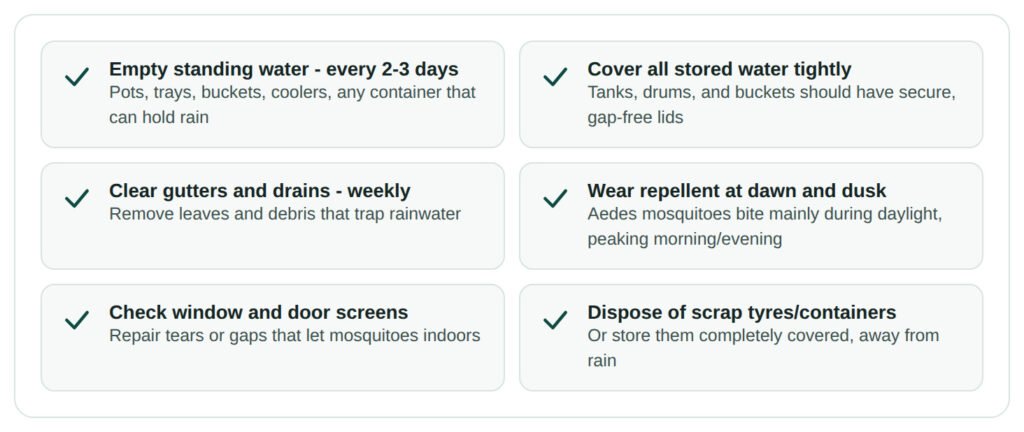
Effective dengue prevention at home comes down to a short, repeatable routine: empty standing water every 2–3 days, cover all water storage, clear gutters weekly, use repellents at dawn and dusk, and keep window/door screens in good condition.
- Empty standing water every 2–3 days — pots, trays, buckets, coolers, any container that can hold rain
- Cover all stored water tightly — tanks, drums, and buckets should have secure, gap-free lids
- Clear gutters and drains weekly — remove leaves and debris that trap rainwater
- Wear repellent at dawn and dusk — Aedes mosquitoes bite mainly during daylight, peaking early morning and before sunset
- Check window and door screens — repair tears or gaps that let mosquitoes indoors
- Dispose of scrap tyres and containers — or store them completely covered, away from rain
Home Remedies vs Professional Treatment — What Actually Works?
Home remedies like citronella, camphor, and neem oil can reduce mosquito presence indoors, but they don’t reach breeding sites in tanks, gutters, or hidden containers. Professional larvicide and fumigation treatments target the breeding source directly and last considerably longer.
We’ll be direct here, because overselling home remedies would work against the very trust we’re asking you to place in this guide: candles, coils, and natural oils genuinely help reduce mosquito activity in a room for a few hours. They are not a substitute for eliminating breeding sites, and they won’t stop a rooftop tank or a blocked gutter from producing new mosquitoes every week.
| Method | Effectiveness | Typical cost | Long-term protection |
| Citronella plants / candles | Moderate, short-term | Low | Hours, not days |
| Neem oil / camphor | Moderate, short-term | Low | Hours, not days |
| Mosquito coils / plug-in repellents | Moderate, indoor only | Low–medium | One evening at a time |
| DIY larvicide / bleach in tanks | Variable, easy to under- or over-dose | Low | Days to a couple of weeks |
| Professional larviciding & fumigation | High, targets breeding source | Medium | Weeks to a full season, with follow-ups |
The most realistic approach is combining both: use repellents and coils for immediate personal protection, and rely on a proper inspection to eliminate the breeding sites doing the actual damage.
Is It Really an Aedes Mosquito? How to Tell the Difference
Aedes aegypti mosquitoes are small, dark, and marked with distinctive white stripes on the body and legs. Unlike common house mosquitoes, they bite mainly during the day, especially early morning and late afternoon.
Aedes aegypti (dengue mosquito):
- Black body with distinct white stripes on legs and back
- Bites mainly at dawn and dusk (daytime biter)
- Breeds in small amounts of clean, still water
- Stays close to the home — indoors and in shaded outdoor areas
- Known carrier of dengue, chikungunya, and Zika viruses
Common house mosquito (Culex):
- Plain brown or grey body, no distinct stripes
- Bites mainly at night
- Breeds in dirtier, stagnant water such as drains
- Ranges further from homes in search of water
- Mainly a nuisance biter, lower disease-transmission role locally
Dengue Symptoms — and Warning Signs You Should Never Ignore
Most dengue cases cause flu-like symptoms — sudden high fever, severe headache, pain behind the eyes, and joint or muscle pain — and improve within 1–2 weeks. A smaller number of cases turn severe, usually 3–7 days after the fever starts, and need urgent medical attention.
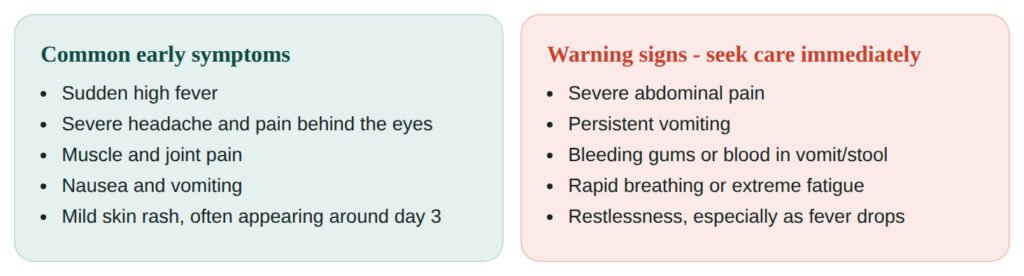
Common early symptoms:
- Sudden high fever
- Severe headache and pain behind the eyes
- Muscle and joint pain
- Nausea and vomiting
- Mild skin rash, often appearing around day 3
Warning signs — seek care immediately:
- Severe abdominal pain
- Persistent vomiting
- Bleeding gums or blood in vomit/stool
- Rapid breathing or extreme fatigue
- Restlessness, especially as fever drops
Medical disclaimer: This information is for awareness only and is not a substitute for professional medical advice. If you or a family member shows any of the warning signs above — particularly as the fever starts to drop — contact a doctor or go to the emergency department immediately rather than waiting to see if symptoms improve.
When to Call a Professional Pest Control Service
Call a professional if you’ve already had a confirmed dengue case nearby, if mosquito activity keeps returning despite regular cleaning, or if your property has hard-to-reach breeding sites such as large water tanks, deep gutters, or a neighbourhood-wide outbreak.
In our own inspections at KNS Pest Management, the same pattern shows up almost every monsoon season: homeowners are diligent about visible containers — buckets, pots, coolers — but overlook rooftop tanks with cracked lids, gutters hidden behind parapet walls, and small drainage pockets on flat roofs. These are exactly the spots a trained technician is looking for during a proper inspection, because they’re the ones that keep producing mosquitoes week after week even when the rest of the house is clean.
A professional treatment typically combines a source inspection, targeted larviciding in water storage that can’t simply be emptied (like main supply tanks), and fumigation for adult mosquito activity indoors and in gardens — giving protection that lasts considerably longer than a single spray can.
Don’t wait for a mosquito problem to become a health emergency — book a free home inspection with KNS Pest Management and get a customized mosquito and dengue prevention plan for your property in Lahore, Islamabad, or Rawalpindi.
Frequently Asked Questions
How can I prevent dengue at home?
Empty and cover all containers that can collect standing water every 2–3 days, keep water tanks tightly sealed, clear gutters weekly, use mosquito repellent during the day, and repair damaged window or door screens. Combine this routine with an occasional professional inspection for hidden breeding sites.
How long can dengue mosquitoes survive in standing water?
The full life cycle from egg to biting adult can complete in as little as 7 to 10 days in still water, which is why containers need to be checked every few days rather than occasionally during monsoon season.
Do mosquito coils and natural repellents actually stop dengue?
They reduce mosquito bites in a room for a few hours but do nothing to eliminate breeding sites like tanks or gutters. Long-term protection depends on removing standing water and, where needed, professional larviciding treatment.
What are the first signs of dengue fever?
Sudden high fever, severe headache with pain behind the eyes, muscle and joint pain, nausea, and sometimes a mild rash around the third day. Most people recover within 1–2 weeks with rest and medical guidance.
When should I go to the hospital for dengue symptoms?
Seek emergency care immediately if you notice severe abdominal pain, persistent vomiting, bleeding gums, blood in vomit or stool, rapid breathing, or unusual restlessness — especially if these appear as the fever starts to drop.
Is professional pest control necessary if I already clean regularly?
Regular cleaning helps, but hidden spots such as cracked roof tanks, gutters behind parapet walls, and rooftop drainage pockets are easy to miss. A professional inspection catches these source points that routine cleaning often overlooks.
Key Takeaways
- Find the hidden breeding spots — tanks, tyres, gutters, and trays are the real risk, not just obvious puddles.
- Build a weekly routine — emptying and covering water every 2–3 days matters more than a single deep clean.
- Know the warning signs — and don’t wait once severe symptoms appear; seek medical care immediately.
- Bring in professionals when needed — for hidden source points and recurring mosquito activity that home efforts can’t fully reach.
About the Author
KNS Pest Management (Private) Limited is a certified pest control and termite management company serving Lahore, Islamabad, and Rawalpindi since 2010. Our technicians specialize in mosquito control, dengue prevention treatments, and eco-friendly fumigation for homes and businesses. Learn more at knspestmanagement.com.
Sources Referenced
World Health Organization — Dengue and severe dengue fact sheet (updated August 2025)
NSW Health, Australia — Dengue fact sheet (updated April 2024)
This article is intended for general awareness and home-prevention guidance only. It is not medical advice and should not replace consultation with a qualified doctor for diagnosis or treatment.